An Introduction to Augmentative & Alternative Communication (AAC)
Communication is an important human need. Through communication, individuals express what they want, share their feelings, connect with others and learn from the world around them. For many people, speech becomes the main way to communicate.
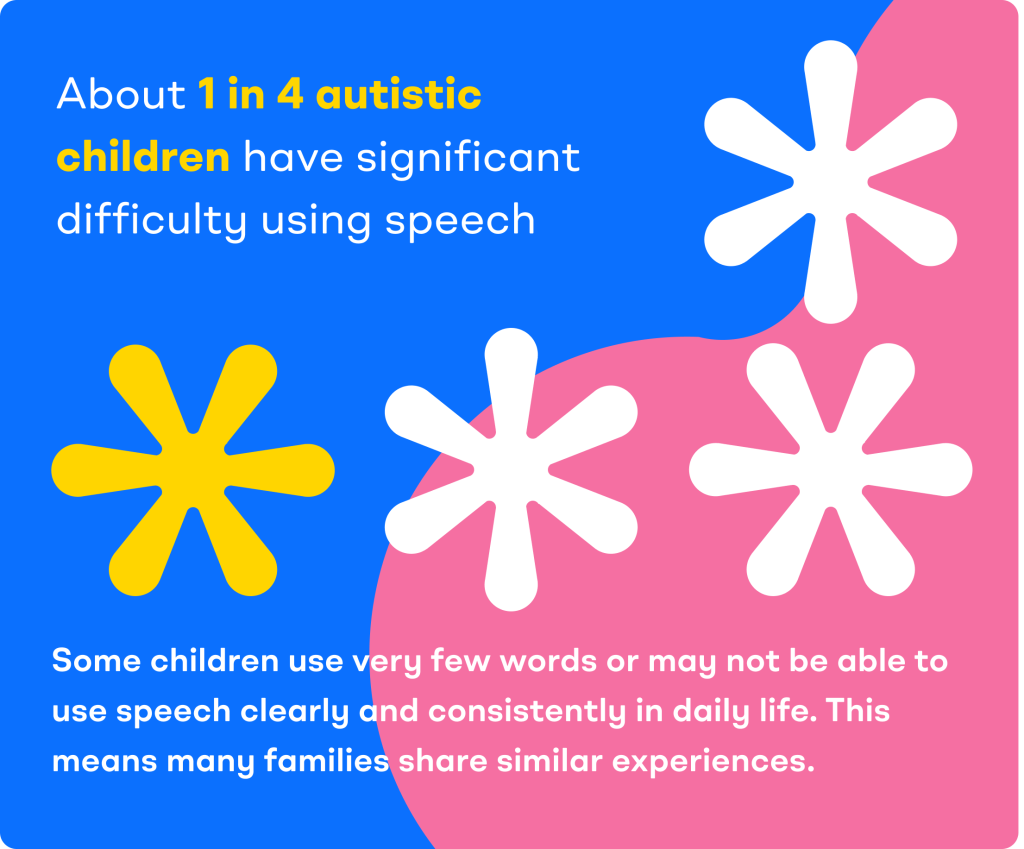
However, not every individual can use speech easily. Research shows that about 25–30% of children with autism are minimally verbal or non-speaking, meaning they use very few words or they cannot use speech clearly and consistently in daily life.
In the United States, studies show that around one in four to one in three autistic children has significant difficulty using spoken language, even after early intervention. In Indonesia, exact numbers are not yet well documented.
However, reports from the Ministry of Health estimate that there may be around 2.4 million individuals with autism in Indonesia. If we use the same global estimate, this means that hundreds of thousands of individuals may have difficulty using speech as their main way to communicate.
Communication Differences and Challenges
Some individuals have difficulty using speech as their main way to communicate. This may include individuals who:
Are not speaking yet or use very few words compared to others their age
Can say some words, but cannot explain what they need
Speak sometimes, but not in all situations
Have speech that is hard for others to understand
Stop talking when they feel tired, stressed or overwhelmed
When speech is difficult, everyday situations can become harder — not because the individual does not want to communicate, but because speech alone may not be enough.
Some children use very few words or may not be able to use speech clearly and consistently in daily life. This means many families share similar experiences.
What This Can Lead To
Over time, this can make it harder to express needs and engage with others, interfering with daily activities as listed below.
Difficulty expressing needs and feelings: The individual may not be able to say when they are hungry, in pain, confused or upset. Instead, they may cry or scream to show what they need. When this happens often, challenging behavior becomes the way they communicate.
Difficulty joining daily activities: Communication is needed for many daily routines, such as choosing food, asking for help, playing with others or following instructions. If an individual cannot say what they want or do not understand what is expected, they may refuse or become upset. Over time, they may join fewer activities because communication feels too hard.
Difficulty learning new skills: Learning happens through interaction with other people. When an individual cannot ask questions or answer easily, learning may take longer. Sometimes the individual understands more than they can show, but cannot express it because communication is difficult.
Difficulty with social interaction and connection: Communication helps people connect with others. When communication is difficult, others may not understand the individual and the individual may feel frustrated or avoid interaction.Over time, this can make social connection harder.
When an individual does not have an easy way to communicate, frustration can build for both the individual and the people around them. These challenges do not mean the individual does not want to communicate. Often, the difficulty is not having a clear way to express it yet. In situations like this, another way to communicate can help.
What is AAC?
AAC means different ways to communicate besides speech. It helps an individual communicate when speech is still developing, when talking is difficult or when speech is not the easiest way for them to express themselves. AAC is not only used by individuals with autism or speech delay.
People use different ways to communicate every day, such as texting or writing instead of talking. Even people who can speak may prefer another way to communicate when they feel stressed or overwhelmed. There are many different types of AAC:
Unaided AAC: Communicating with the body: gestures, facial expressions or body language.
Low-tech AAC: Uses simple tools that do not need batteries or electronics: picture cards or communication boards.
High-tech AAC (communicating with devices): Uses electronic devices that can produce speech or apps such as LAMP Words for Life, Proloquo2Go or TD Snap.
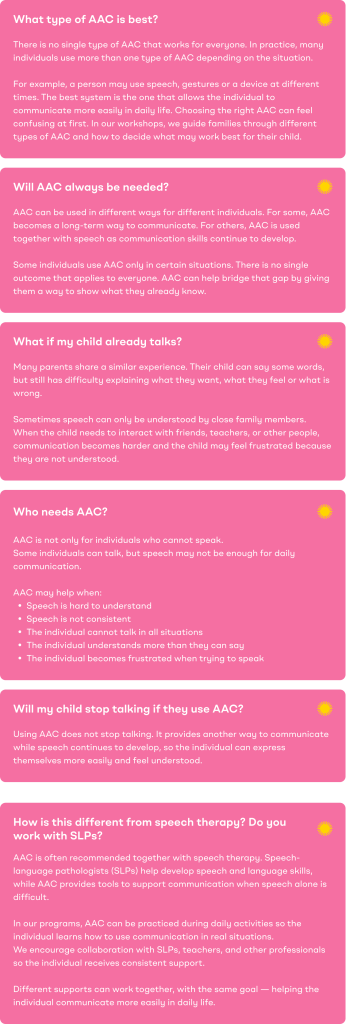
AAC does not take communication away — it gives more options. It allows individuals to be understood, connect with others and be more involved in daily life.
Concerns About AAC and Speech Development
A common question about AAC is whether using pictures, signs or devices will make an individual stop talking, or reduce the chance of speech developing. Some people wonder:
If AAC is introduced, will the individual stop trying to talk?
Will AAC replace speech?
Does using AAC mean giving up on spoken language?
These questions are very common, and they have been studied by researchers and professionals for many years. Research shows that AAC does not stop talking from developing. In many cases, communication improves, and some individuals also begin to use more spoken words after AAC is introduced.
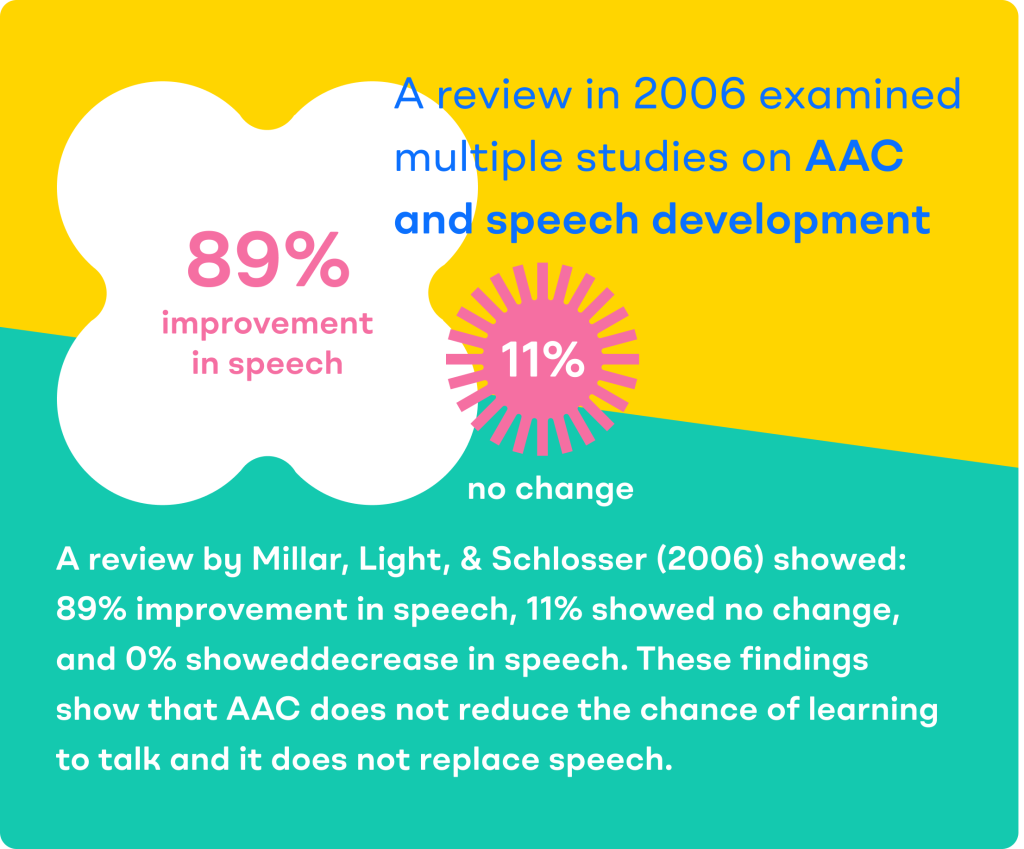
A review by Millar, Light, & Schlosser (2006) examined multiple studies on AAC and speech development. The results showed: 89% improvement in speech, 11% showed no change, and 0% showed a decrease in speech. These findings show that AAC does not reduce the chance of learning to talk and it does not replace speech.
Real Experiences With AAC: Learning from Lived Perspectives
Research gives important information, but real experiences show what communication means in everyday life. Every communication journey is different, but many experiences share something in common: When an individual has a way to communicate, they are often able to show abilities that were always there.
For many families, having a way to communicate changes daily life — not only for the individual, but for everyone around them.
“Parents don’t need their dreams taken away. They need support in building new dreams that fit the child they have.”
— Barry Prizant, an Autism Specialist
You can hear some of their experiences below:
“Parents Using AAC”
“How to Use AAC at Home”
“Communicating with AAC: A Parent’s Experience”
Communication in Everyday Life
Many families share that before their child had a way to communicate, it was hard to understand what they needed or how they felt.
In Jakarta Behavior Center, we design our support based on the experiences of autistic individuals and the daily challenges shared by families. We believe that communication skills can develop in different ways, depending on the needs of each individual and their family.
For this reason, our programs focus on functional communication in everyday life, while working closely with parents and other professionals involved in the individual’s development. Our goal is not only to teach communication during therapy sessions, but to make sure communication can be used at home, at school and in everyday life.
Integrated ABA Therapy with AAC support:
AAC can be included as part of the child’s ABA therapy program. Communication is taught during daily activities so the individual learns how to use communication in real situations. Parents and caregivers are involved so communication can continue outside therapy sessions, including exercises such as:
Training parents and caregivers about best-practice communication strategies
Regular check-ins to support consistent use of AAC at home
Optional teacher / shadow teacher training for school settings
Parent AAC Training (Dedicated AAC Support)
In this program, we provide AAC training for parents so they can teach and support communication in daily routines. This service focuses on coaching parents to use AAC with their child at home, rather than having the child attend regular therapy sessions. This includes:
Parent training: Learning how to use communication boards or speech devices step by step.
Home check-ins: Adjusting strategies so AAC works in the natural environment.
Guidance for caregivers, teachers, and other adults involved in the child’s daily life: So the same communication system is used consistently across settings.
Training and Workshops
We also provide training for parents, educators and therapy centers who want to learn more about AAC and communication support. Our goal is to help more individuals be understood and included at home, at school, and in the community around them.
Millar, D. C., Light, J. C., & Schlosser, R. W. (2006). The impact of augmentative and alternative communication intervention on the speech production of individuals with developmental disabilities: A research review. Journal of Speech, Language, and Hearing Research, 49(2), 248–264. https://doi.org/10.1044/1092-4388(2006/021)
Tager-Flusberg, H., & Kasari, C. (2013). Minimally verbal school-aged children with autism spectrum disorder: The neglected end of the spectrum. Autism Research, 6(6), 468–478. https://doi.org/10.1002/aur.1329
Kementerian Kesehatan Republik Indonesia. (2018). Estimasi jumlah penyandang autisme di Indonesia. (Data estimasi populasi nasional)
Prizant, B. M. (2015). Uniquely Human: A Different Way of Seeing Autism. New York: Simon & Schuster.
Kedar, I. (2012). Ido in Autismland: Climbing Out of Autism’s Silent Prison. Sharon, MA: Sharon Publications.
Higashida, N. (2007). The Reason I Jump: The Inner Voice of a Thirteen-Year-Old Boy with Autism. New York: Random House.