Understanding Profound Autism: Support Individuals with Greater Needs
What is Profound Autism?
Within the autism spectrum, some individuals need much more support than others in their daily life. The term profound autism is often used to describe individuals who require very high levels of support, including help with communication, safety and everyday activities.
This is not a formal diagnosis label. However, doctors and researchers use this term to describe a group of individuals on the spectrum who require significantly more support than others, so that their needs can be better understood and appropriate services can be provided.
What Research Shows
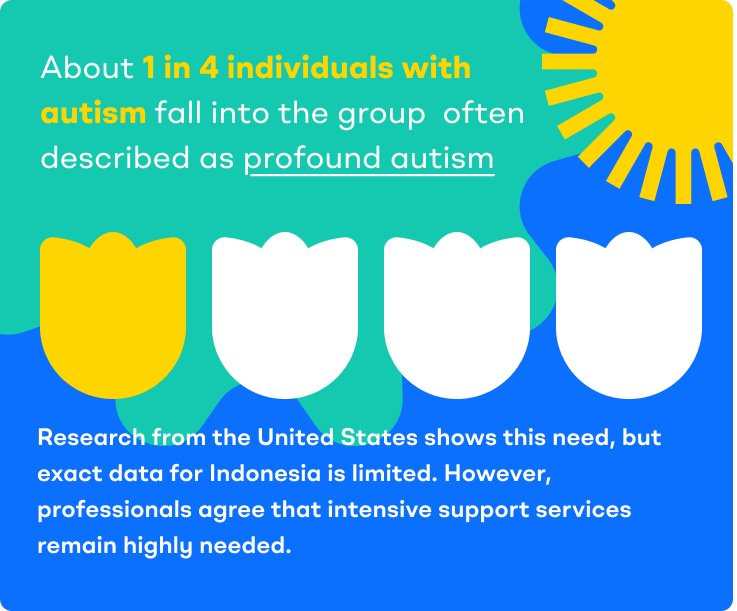
Research from the CDC (Centers for Disease Control and Prevention, a public health agency in the United States) suggests that about 26.7% individuals with autism fall into the group often described as profound autism.
In most cases, individuals in this group:
Need 24/7 help with daily activities: They often require assistance or supervision from an adult for many daily tasks, such as eating, dressing, bathing, using the toilet or staying safe in different environments
Significant learning difficulties: More time and more support may be needed to learn new skills.
Difficulty with communication: Some individuals may not speak or may use only a few words.
In general, the term profound autism is used when several of these characteristics are present together, not just one on its own. This is why individuals in this group usually require ongoing, intensive support across many areas of life.
For more information and updates on research and resources:
Profound Autism Alliance
*This data comes from research in the United States. At this time, there is not enough research to know the exact numbers in Indonesia. However, professionals in the field recognize that there are many individuals who require very intensive support and appropriate services for this group are still greatly needed.
Learning and Understanding in Profound Autism
Many individuals described as having profound autism also experience intellectual and learning difficulties. Large population-based research, such as data from the Centers for Disease Control and Prevention (CDC), shows that many individuals in this group meet criteria for intellectual disability. This means they may need more time and support to learn new skills and navigate daily life.
However, cognitive ability in autism is complex and not always accurately captured by standard testing, especially for individuals with limited speech or motor differences. Many traditional assessments rely on skills like speaking, pointing, following verbal instructions or responding quickly—areas that may be challenging, even when understanding is present.
A helpful way to think about this is: It can be like knowing the answer, but not being able to say it out loud.
This means that:
Communication challenges do not always reflect understanding
Some individuals may understand more than they are able to express
Because of this, access to communication—such as AAC (Augmentative and Alternative Communication)—is especially important. When individuals are given the right tools to express themselves, we can better understand their abilities, needs and potential.
At the same time, many individuals with high support needs also benefit from structured support in everyday life skills. These skills—such as eating, dressing, toileting, and following routines—are important because they directly affect a person’s safety, comfort and independence in daily life.
For many families, these day-to-day skills are more immediately important than academic learning. Building these foundations helps individuals participate more fully in daily life and creates a stronger base for future learning.
As a result, “profound autism” is best understood as a description of high support needs, rather than a precise measure of cognitive potential.
What does this mean for therapy?
For individuals with very high support needs, therapy focuses on helping them live a safer, more comfortable and more independent life — step by step.
At Jakarta Behavior Center, we use ABA (Applied Behavior Analysis), a therapy approach that has been widely studied and used internationally to help individuals with autism learn important life skills. For individuals with profound autism, therapy focuses on practical skills that make everyday life easier and safer, as stated below.
Communication Support (AAC)
Many individuals benefit from AAC (Augmentative and Alternative Communication), because it helps them express their needs, wants and feelings. This may include:
Tablets or speech devices (e.g., LAMP)
Communication boards
When individuals are able to communicate, we can better understand their thoughts, reduce frustration and support their learning more effectively.
Daily Living Skills
We teach practical skills that are important for everyday life, such as:
Eating
Dressing
Toileting
Following daily routines
These skills help individuals become more independent, safe and comfortable in their daily environment.
Emotional and Behavior Regulation
We help individuals:
Manage big emotions
Cope with frustration or change
Learn safer ways to respond in challenging situations
This also includes reducing behaviors that may be unsafe and replacing them with more functional skills.
Community Skills
Practicing skills needed to participate in everyday activities outside the home, such as going to the supermarket, visiting a cafe or being in public places safely.
Leisure Skills
Helping individuals learn how to enjoy free time in meaningful ways, such as playing, listening to music, doing simple hobbies or participating in activities with family.
“Progress may look different for every individual, and that is okay. Our goal is not perfection — our goal is a better quality of life for the individual and the family”
You can hear more testimonials below:
Autism Science Foundation
Ibu Mulan’s story and experiences
Conclusion
Caring for someone with high support needs is not always easy. Many families feel tired, worried, or unsure about what to do next. At Jakarta Behavior Center, we support families using approaches based on research, experience, and practical strategies that can be used in daily life.
Our Collaborative Approach
We believe the best progress happens when families and professionals work together. You know your child best, and we are here to provide professional guidance to help find the most appropriate approach for each individual and family. Our services are designed to meet your family where you are.
Parent Training: We help parents learn practical strategies to manage behavior and support their child’s development at home
Home Observations & Check-ins: We observe your child in their natural environment so therapy recommendations truly fit daily life
Support for Challenging Behavior: We work with families to find safe and practical ways to manage challenging behavior, help individuals learn emotional regulation and reduce situations that may become overwhelming
Caregiver and Teacher Training: We provide training for caregivers, teachers, and support staff so everyone understands the individual’s needs and can use consistent strategies
References
Autism Science Foundation – Summary of research on profound autism and support needs
Association for Science in Autism Treatment (ASAT). (2026). ASAT Responds to the New York Times: Should the Autism Spectrum Be Split Apart?
Centers for Disease Control and Prevention (CDC) – Autism prevalence and characteristics data (ADDM Network)
Hughes, M. M., et al. (2023). The Prevalence and Characteristics of individuals With Profound Autism, 15 Sites, United States, 2000–2016. CDC Stacks.
Lord, C., et al. (2021). The Lancet Commission on the future of care and clinical research in autism.
Profound Autism Alliance. (2026). Profound Autism Facts: Why The Term Profound Autism is Needed.
Profound Autism Alliance. (n.d.). Profound Autism Research Strategic Plan
Wachtel, L. E., et al. (2024). Profound Autism: An Imperative Diagnosis. PubMed.